
BOLD Perspectives: Innovative Entrepreneur and Sustainability Pioneer -- Verena Judmayer
 Verena Judmayer is the Chief Dream Officer of Metro, an Austrian startup working to revolutionize the mattress industry. As Chief Dream Officer, Verena leads with her visionary approach to addressing issues like mattress waste through sustainable and innovative solutions.
Profile
Name: Verena Judmayer
Age: 29
Title: CEO and Co-Founder, “The Chief Dream Officer”
Company / Project name: MATR – “Make sleep matter!”
Area of Expertise: circular product and service development, circular economy, international business and entrepreneurship, innovation consulting, financing and strategy. “I’m an allrounder!”
City of Residence: Vienna, Austria
Vision/Philosophy/Motto: I would love to wake up in a world where waste was no longer a problem. I want to end mattress waste and I want to use the time I have to do something for a better future.
I am BOLD because … I dare to do things differently by creating a circular economy solution instead of sticking to the regular way.
First thing that comes to mind when you think of Austria? Mountains. The Alps.
How to be innovative
Tell us about your professional background. Are there any milestones you are particularly proud of?
I studied at FH Johanneum in Graz and did my Bachelor’s in international management. I had some experience working in the banking sector during one of my internships. Then I moved to Vienna to do my Master’s in export management and internationalization processes at the University of Economics and Business.
One of the most interesting jobs I have had so far was my job at Waterdrop. They had just started the company and I was part of that very small team at the beginning — now they are present all over the world. Their journey is amazing. There I got to learn how to try out new things as a young company with little budget. I learned to be open-minded about what the future might look like.
Sometimes, initiatives just don’t work out. Then I worked at Pioneers as an innovation consultant for three years. I learned about design thinking and how to start with a problem, come up with ideas, and evaluate them quickly.
What has been the most valuable lesson life has taught you thus far?
The time when I was growing most as a person was the first year of being a startup founder. You have this idea in your head but no clue how to actually make it a reality. You just start at some point — at something — but you are always in a battle.
Sometimes it’s great, then it sucks, you are always questioning yourself or your idea, which helps you to grow and become better. At the same time, it makes you persistent in what you are doing and resilient as well.
There are challenges coming your way in areas where you have no expertise in. You learn how to ask for help when you do not have certain knowledge yourself, which is super important. You learn how to deal with setbacks and how to make sure you are not “breaking up” with your project.
You learn how to breathe and how to be healthy so you can run this marathon.
How does being a part of the BOLD Community influence you and your work?
With the community, I have access to such a unique bunch of people who I would never have met otherwise. I get to talk to people who are active in so many different areas and are geniuses in their areas. The events are so fun, the people are so special, talented, forward-thinking. You can feel they are handpicked; that proves how valuable diversity is in any sense. You learn so much by just being with these people. I can also take the inspiration to my daily business, applying tools, approaches, and experiences we’ve discussed in our context.
What strategies do you implement to cultivate a culture of innovation within your organization?
We are always questioning what we do and try to take it a step further than what is standard on the market. It is in our DNA to think outside the box, involve our customers, and try out ideas quickly. We ideate as a team and evaluate, together, which ideas are worthwhile to take further. Usually, we all don’t know exactly how it’s going to work. That’s why we are always trying, testing, and iterating. You have to take the risk and be BOLD!
Is there a particular belief or philosophy that guides your approach to life and work?
Do something that has meaning and purpose. We are working for a greater good; that drives Michaela and I. We want to make a change, be part of something bigger. We are trying to make other people join us on this mission.
What do you think people should learn from each other to foster innovation and collaboration?
Usually, the biggest barrier when you are trying to be innovative is having the guts to get started. To take the first risk. Learn from each other to get inspired and take influence from the way other people are doing new things. That has been invaluable to us: going out there instead of working from our laptops, getting constant feedback. If it hurts, you know where to make the adaptations. Failing forward is key.
What qualities do you believe will be crucial for success in the future of work?
To have problem awareness and solution-oriented thinking. I am not talking about solutions you have been told about, I am talking about using your own intelligence and creativity to find new solutions for the problems you see in the world. If your job is redundant, you have to adapt and develop new skills.
Can you share an instance where a failure or setback led to a positive outcome or growth?
Not too long ago, we were looking for partners with whom we could create a new mattress together and we were sure it would work out. In the end, it didn’t work so well and there were issues in the production and with the materials — so we had invested quite a lot of time and had to realize it is not the point in time to work with them.
That was quite frustrating since this plan was connected to other projects and essential for the company's growth. But then we realized the number of things we’ve learned throughout this journey, like what specific criteria are key for our partner choice, how to structure the process efficiently, and when it’s time to take a step back.
Even though it didn’t work out the first time, this learning experience was so important for us and our growth; it helped us much more to be better for the future.
What is a BOLD decision you made in your career and why?
To switch from being employed to being self-employed, I had to make a big adjustment. When I was working as a consultant, my job was to give advice, facilitate projects, and create concepts. However, I never had to actually do any of the work myself. It was a comfortable position to be in, where I could come up with ideas and support others in bringing them to life without taking any risks myself.
But when I became a startup founder, everything changed. I had to learn what it really means to put ideas into action and make them a reality. I had to navigate through all the challenges and obstacles that came my way. I had to take on responsibility for my own actions and the actions of my company. And most importantly, I had to carry the risk on my own shoulders.
It's a completely different world, but it's also an incredibly exciting journey. And it's even better when you have a great founding team to share it with.
Explain your innovation
Can you explain your innovation and why it matters?
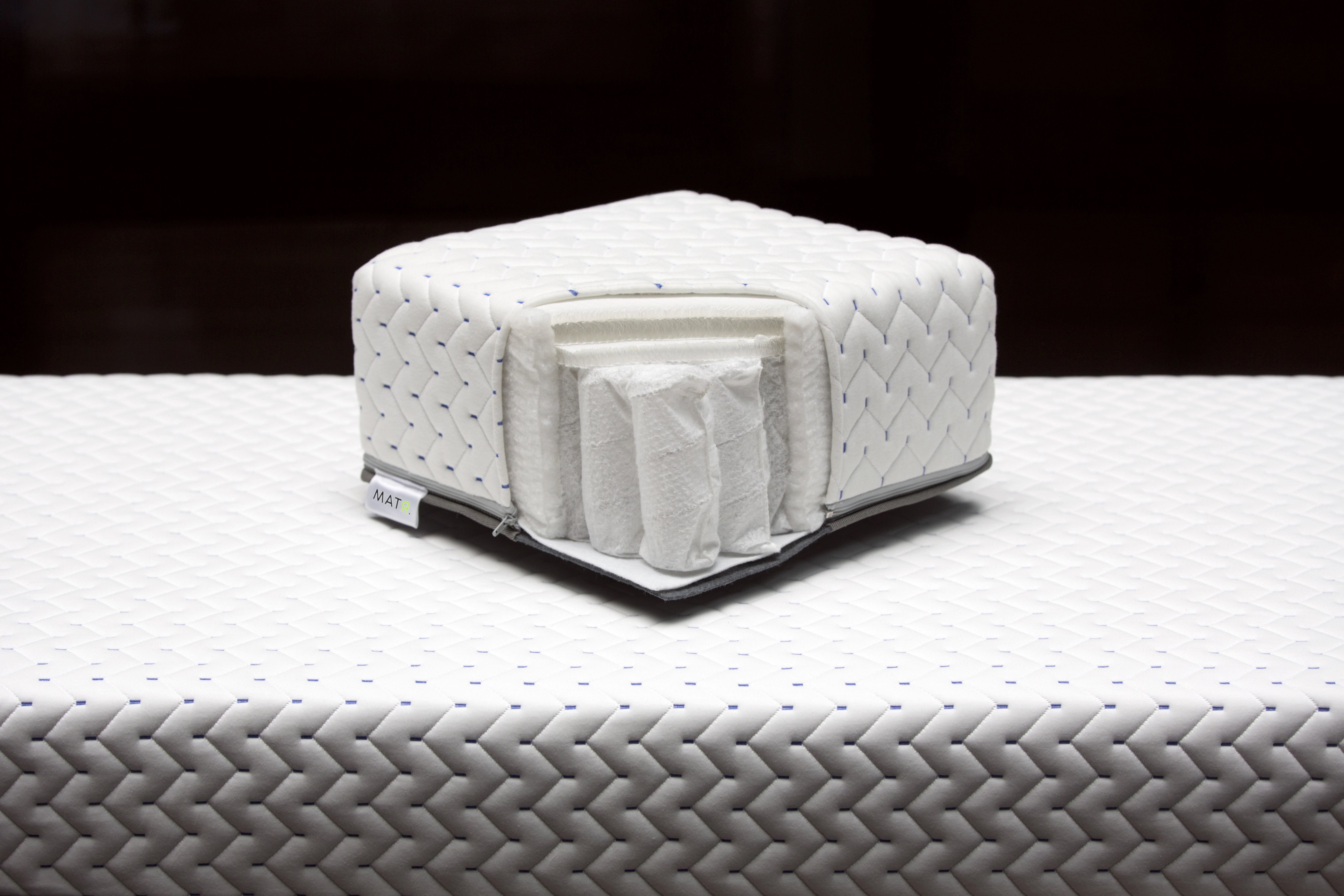
We created a mattress that is completely recyclable. All the materials can go back into the material loop, which is called circular design. Right now, 30 million mattresses go to waste every year in Europe. That is quite a huge number. That is about 20,000 times the Eiffel Tower.
With our service model, we aim to make a difference and change that wasteful behavior towards a more circular behavior in which we increase resource efficiency and preserve nature in the end. It is about making sure we can have a positive impact on the planet and people.
We work with hotels; they use the mattresses for five years or longer. It’s key to maintain the product well in order to extend its lifetime, for example, by cleaning the cover regularly or exchanging it when needed. At the end of the mattresses’ time at the hotel, we pick them up, take them back, and check the quality.
Some mattresses can be refurbished and reused, others reach their end of life and go to recycling. We only use two recyclable materials: steel and polyester. They can easily be separated in a clean way, thanks to the special glue we use.
With our partners, we take care of disassembling the mattresses, sorting the materials, and taking them to the steel recycler and polyester recycler, respectively. They process our material and bring it back into the material loop at its highest value to become a new product of any kind. That’s how our mattress material circulates over many years.
Our production partner is based in the Netherlands. The suppliers of the components and mattress ecosystem partners are all based in Europe.
How did you get involved in this?
My co-founder and I were both working as Senior Innovations Consultants and became familiar with the topic of mattress waste at an event called “Impacthon.” It was on a gray November weekend during the Corona lockdown, we were sitting at home in front of our laptops, and one of the challenges was “Mattress Waste and How to Solve It.”
We both decided to go for this challenge and wanted to come up with a solution. So basically within a weekend, the idea of MATR was born. We decided to explore further if this could work out. About a year of working on the idea next to our full-time jobs, we decided to jump on that roller coaster and commit to it fully.
Neither of us was necessarily experienced with mattresses or hotels. The topic caught our attention so quickly because, in the end, every person spends a third of their lives on mattresses — if they sleep eight hours a night, which they hopefully do (laughs).
A lot of people think about what they eat and what kind of transportation they use in order to be more sustainable, but not many people think about what happens to their mattress after they throw it away. It is a very good example for the circular economy. If I have a mattress that consists of recyclable materials, it is less bad, but at the end of the day, the mattress still goes to incinerators and landfills.
The idea is to think more holistically: to think about the whole lifetime of a product, to make sure to expand it as much as possible, and to not forget the end of the cycle.
Describe a cycle for one of these mattresses?
We work with hotels. They use the mattresses for at least five years, hopefully even longer. Our mattresses have different parts that are exchangeable and that way we can prolong the mattresses “life,” so that is the first step.
But once they cannot be used anymore, we come to our customers and pick up the mattresses, we check the quality. If they need to be recycled because, for instance, the springs are worn out, we bring them to our disassembling partner who separates the different materials.
The cool thing is, we use only two mono-materials, steel and polyester. They are pure and therefore efficiently recyclable with existing technology, preserving the value and quality at very high levels. We make sure they are clean and get back in the recycling process. The steel goes to a steel recycler and the polyester to a polyester recycler. The material goes back into the loop so they can become whatever high value product out there, for instance, yoga pants, outdoor gear, or even new mattress fabric.
That is remarkable because, most of the time, after being used, materials are only downcycled, so they are only used for minor quality products.
For the future, we aim to make new mattresses fully out of recycled material and control the whole cycle.
Who builds your mattresses?
We have our production partner in the Netherlands. They produce our mattresses, and actually all our suppliers for the components (like springs, covers, comfort layer) are based in Europe. The mattresses are transported via truck. We are looking into the option of using trains but right now that is not possible due to logistic reasons.
We are the only ones in the German-speaking market who combine a mattress based on circular design with add-on service packages and rental options for hotels in a mattress-as-a-service model, ensuring to close the cycle. Regarding the consumer market, similar mattress models exist on the Dutch market — where a take-back system, which doesn’t exist yet here in Austria, already exists on a national level. For now, there are only a handful of companies providing an actual circular economy mattress solution like us.
Are you planning on selling to consumers as well?
They are an interesting target group but we first have to make sure that the take-back process for consumers works before we start selling it to them. We are looking into it. Potentially in a couple of years, we will be able to do that.
How can others contribute to this effort?
Everyone can contribute by starting to not only think about where a product and its materials come from but also where they go after use, critically reflecting on the sustainability messaging out there and educating themselves on circular economy.
For our efforts as a company, it is very helpful to connect with open-minded hotel chains or hoteliers who are open to using our solution. The more mattresses we can bring onto the market and into the loop, the more change we can create. We love to hear ideas, get feedback, and exchange with experts about further product development options. Right now, we are using polyester, but if there is, for instance, any material scientist who is knowledgeable about which alternatives we could use, let us hear it.
On top of this, we continuously grow the mattress and tourism ecosystem and foster their transformation towards a circular economy. Therefore, we are very much interested in collaborating with tourism regions in Austria, South Tyrol, or South Germany as well as regional production, recycling, and disassembling partners.
Quickfire Questions
What's your power breakfast before a big day of innovation?
Porridge with some fruit.
The last book you've read that inspired an innovative idea or approach:
Option B by Sheryl Sandberg.
If you could master a new skill instantly, what would it be and why?
I would love to be able to code.
What are your strategies for maintaining work-life balance and prioritizing self-care?
My co-founder Michaela Stephan and I hold each other accountable. Not only for our business but also for our personal health. We make sure to not collect too many working hours per week and take weekends off. Also, if someone forgets to take a holiday, for example, we kindly remind each other. The most important thing to maintain a good work-life balance is to have people you trust one hundred percent and who can keep the company running when you are not there. It feels good to always have somebody who has your back and gives you peace of mind.
Everyone needs time with friends and family, to do sports, or whatever clears your head. For me, doing a sport is very important to release stress. I love running, climbing, hiking, and doing yoga. Everyone needs to find what works best for them. Don’t be too hard on yourself, it needs to benefit you, don’t force yourself to do it. Reading and journaling is also very good and helps to calm the mind.
If you could choose any innovator (real or fictional) as a mentor, who would it be and why?
Verena Pausder, the work she is doing is very inspirational. I would love to have her as a mentor — and not only because we have the same first name (laughs).
Your favorite podcast that sparks creativity or offers insightful business trends:
“Fast & Curious” with Verena Pausder and Lea-Sophie Cramer.
What is the most exciting innovation you've recently encountered in your field?
There’s a lot going on in the fields of sleep science and biohacking. In the space of mattresses, for example, there are smart solutions that adjust the mattress’ conditions based on what you need each night, for example, in terms of temperature or softness.
If you could invent any gadget to make your work life easier, what would it be?
I would love to have a little fairy who does all the housework for me.
What achievement, opportunity, or aspect of your work are you most thankful for?
For my amazing co-founder, Michaela, who is my partner in crime on this entrepreneurial journey and who is one of the key reasons why we have made it so far already.